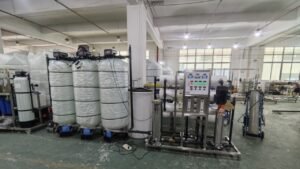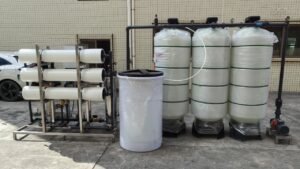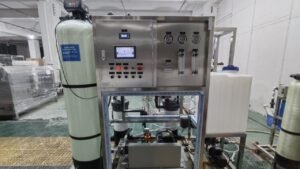

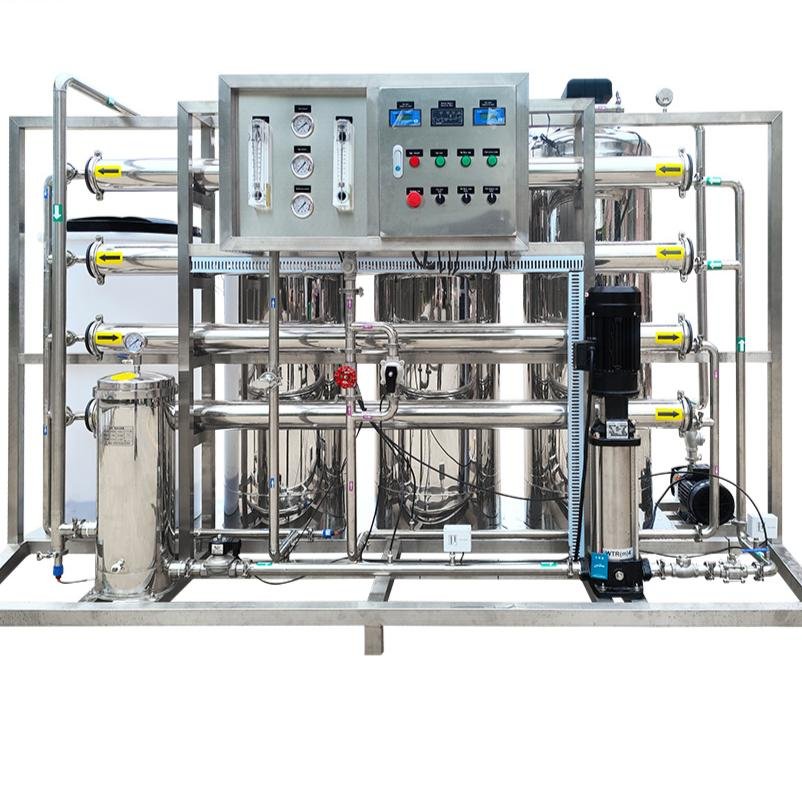
Equipment list for water systems in food and beverage processing
Important Note: This list addresses the process water requirements for the food and beverage industry (such as juice preparation, beverage bottling, and ingredient extraction), emphasizing hygienic design, food-grade materials, and microbial control to ensure compliance with GB 5749 National Standard for Drinking Water Quality and even stricter internal company standards.
System Technical Overview
Project: Specification Description, System Model: Food-RO-250S
Core Process: Multi-media filtration + Activated carbon filtration + Softening + Precision filtration + Reverse osmosis + UV/Ozone sterilization
Designed Water Production Capacity: 0.25 cubic meters/hour
Inlet Water Source: Municipal tap water or well water meeting standards
Product Water Standard: Meets relevant food processing water standards, total bacterial count ≤100 CFU/mL
Typical Applications: Small and medium-sized beverage plants, dairy processing, condiment production, food raw material cleaning and preparation
II. Core Configuration List and Industry Highlights
Module 1: Pre-treatment and Softening
Quartz sand/manganese sand filter: For groundwater, removes iron, manganese, and suspended solids.
Fully automatic softener: Prevents scaling in subsequent equipment and ensures heat exchange efficiency.
Key points: Material certification, all water-contacting parts must have food-grade certification (e.g., NSF/EC1935/2004), and rubber parts are FDA silicone or EPDM.
Module 2: Reverse Osmosis Purification Unit
Sanitary high-pressure pump: Stainless steel material, high machining finish.
Sanitary RO membrane housing and elements: Can use membrane elements that meet FDA standards.
Key points: Sanitary connections, prioritizing sanitary clamp quick connectors (SMS/DS/ASME BPE standards), and avoiding sanitary dead ends at threaded connections.
Module 3: Sterilization and Storage Assurance
Ozone mixing generator + stainless steel contact tower: Provides effective sterilization of product water; residual ozone can be removed by ultraviolet light.
Or/and pasteurization heat exchanger: circulates and sterilizes pure water at 80-85℃.
Aseptic storage tank: With sanitary breather (0.22 μm air filter) and spray ball, ensuring the tank can be cleaned in place (CIP).
Key points: Microbiological control, the system design must eliminate dead water areas, and the distribution pipelines should have a slope and be able to be completely drained.
Module 4: Anti-pollution Design
Circulating conveying pipeline: The product water side always maintains a turbulent circulation state to prevent microbial growth.
Sampling valve: Uses aseptic diaphragm sampling valve. Key points: Surface finish: all stainless steel surfaces in contact with liquids shall have a surface roughness of Ra ≤ 0.8 μm and undergo pickling and passivation treatment.