

3T Seawater Purification System
The “3T Seawater Purification System” is a small, compact seawater desalination system with a daily processing capacity of 3 tons (approximately 125 liters per hour). The core of this type of system lies in its use of high-pressure reverse osmosis technology to convert high-salinity seawater into freshwater that meets standards.
Key Technologies and Selection Considerations
- Core Technology: The core technology is high-pressure reverse osmosis, typically requiring pressures of 6.0-8.0 MPa, far exceeding ordinary brackish water desalination systems (approximately 1.5 MPa). All flow channels must be constructed using chloride-resistant materials such as SUS316L stainless steel.
- Equipment Composition: A typical system integrates multi-stage filtration pretreatment, a high-pressure pump and energy recovery device (for energy saving), seawater RO membrane modules, a PLC control panel, and a post-treatment unit.
Important Parameters:
- Desalination Rate: Typically higher than 99.3% under stable operation.
- Recovery Rate: Limited by the high salinity of seawater, the recovery rate is relatively low (approximately 15-30%), resulting in a large concentrate volume.
- Energy Consumption: Early systems consumed approximately 5-8 kWh of electricity per ton of water; newer systems equipped with energy recovery devices can reduce this to 2.5-3.5 kWh.
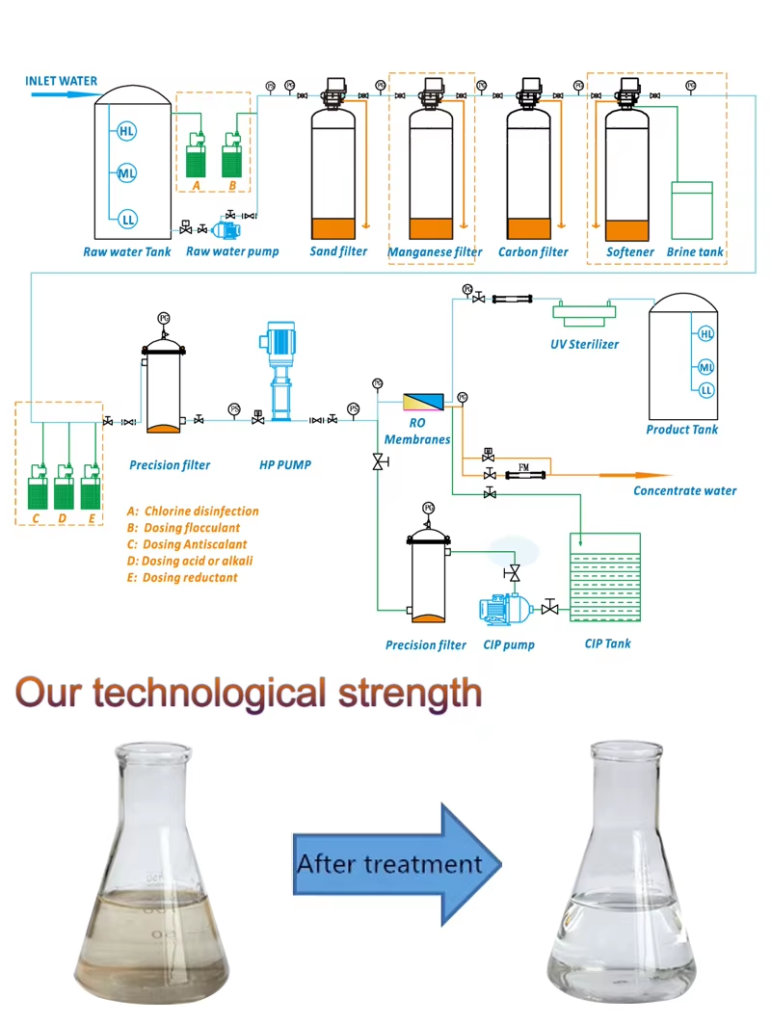
Key System Characteristics
| Feature | Description |
|---|---|
| Primary Goal | To transform high-salinity seawater (TDS ~35,000 ppm) into drinking or domestic water. |
| Core Technology | High-Pressure Reverse Osmosis, typically operating at pressures above 6.0 MPa. |
| Key Components | High-pressure pump (e.g., CAT Pump), seawater-specific RO membranes (e.g., DOW SW series), all wetted parts made of corrosion-resistant materials like SUS316L stainless steel. |
| Typical Recovery Rate | Approximately 15-30%, meaning 3-7 tons of feed seawater are required to produce 1 ton of fresh water. |
| Product Water Quality | Product water TDS can be reduced to < 500 ppm, complying with drinking water standards. |
| Main Applications | Small fishing boats, yachts, offshore platforms, island outposts, and coastal households with water scarcity. |