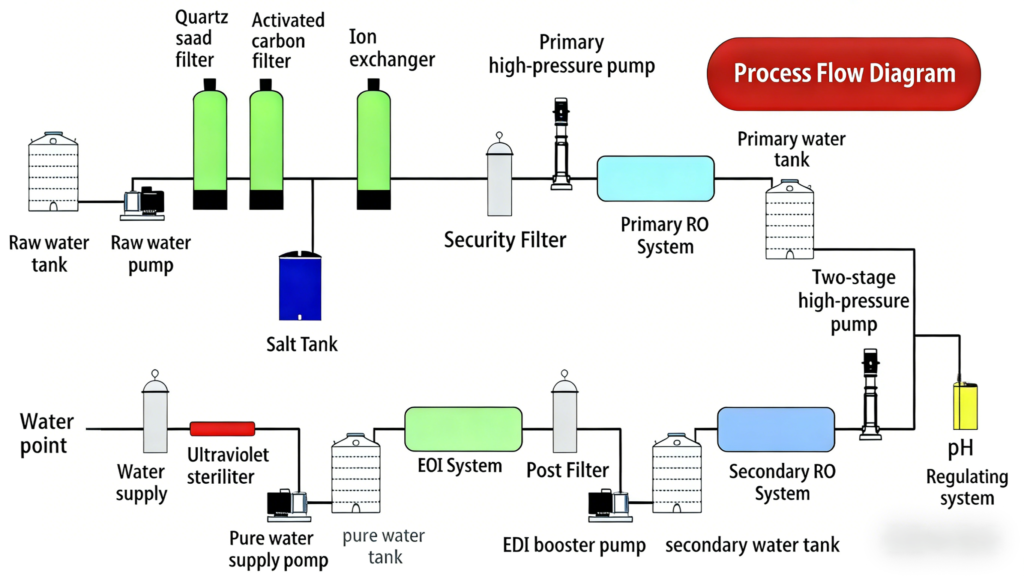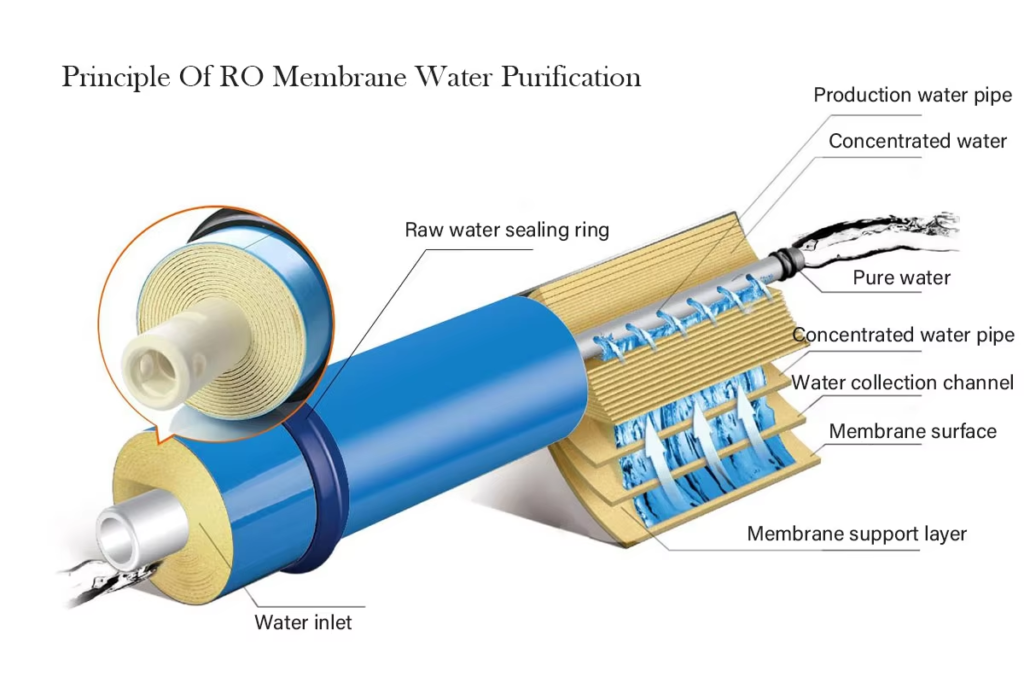

Reverse Osmosis (RO) serves as the primary desalination step, removing approximately 99% of dissolved ions, organics, and microbes. The two-pass RO ensures feed water quality for the EDI module meets stringent requirements.
Electrodeionization (EDI) acts as the final polishing stage. It uses a direct current electric field to drive ion migration through ion-exchange membranes and resin, continuously producing high-purity water without the need for chemical regeneration.
 Key Features & Advantages
Compared to traditional mixed-bed ion exchange (MB), the EDI-RO combination offers significant operational benefits:
| Feature | EDI-RO Integrated System | Traditional Mixed-Bed Ion Exchange |
|---|---|---|
| Operation Mode | Continuous production, no downtime for regeneration. | Batch process. Requires periodic (days/weeks) shutdown for chemical regeneration. |
| Chemical Use | No acids or alkalis needed for regeneration. Eliminates hazardous chemical handling and waste disposal. | Heavily reliant on acids and alkalis for resin regeneration, with associated safety and environmental costs. |
| Water Quality Stability | Produces consistently high-purity water (typically 15-18 MΩ·cm resistivity) with no end-of-cycle quality decay. | Water quality declines through the service cycle, peaking after regeneration and falling before the next. |
| Automation & Space | Highly automated, easy PLC integration. Compact, modular design with smaller footprint. | Complex regeneration procedure often requires manual operation. Larger equipment footprint. |
| Operating Cost | Higher initial capital investment, but lower long-term operating cost (no chemicals, minimal waste, less labor). | Lower initial investment, but higher recurring operating costs (continuous chemical purchase, waste neutralization, and labor). |
Critical Feed Water Requirements for EDI:
The upstream RO system must condition the feed water to meet strict EDI inlet specifications:
Conductivity: Typically <40 μS/cm, optimal at <10 μS/cm.
Hardness (as CaCO₃): <1.0 ppm to prevent scaling.
Silica (SiO₂): <1.0 ppm, preferably <0.5 ppm.
Total Organic Carbon (TOC): <0.5 ppm.
Free Chlorine/Oxidants: <0.05 ppm to prevent oxidative damage to membranes and resin.