
UF 1.5t/H Ultrafiltration Pure Water
A 1.5 t/h UF Ultrafiltration Pure Water system refers to a water treatment setup centered around an Ultrafiltration (UF) membrane technology, with a standard production capacity of 1.5 tons (1,500 liters) per hour.
Ultrafiltration is a pressure-driven membrane filtration process. It uses membranes with pore sizes typically in the range of 0.01 to 0.1 microns (1,000 to 500,000 Daltons Molecular Weight Cut-Off, or MWCO).
Mechanism: It works primarily on a size-exclusion principle. Water and small dissolved molecules (salts, ions) pass through the membrane pores as “permeate.” Larger suspended solids, colloids, bacteria, viruses, and high-molecular-weight organics are physically retained as “concentrate” or “retentate.”
Key Point: UF does not remove dissolved salts or ions. It is excellent for clarification, disinfection, and macromolecule separation.
⚙️ System Configuration: A 1.5 t/h UF Unit
A standard skid-mounted 1.5 t/h UF system typically includes:
Prefiltration: A ~100-micron cartridge filter to protect the UF modules from large debris.
Feed Pump: Provides the necessary pressure (typically 1-5 bar).
UF Membrane Modules: The core components, often arranged in an array. Common formats are hollow fiber or capillary tube modules.
Automated Control Valves & PLC: Manages the cyclic operation of filtration → backwash → chemical enhanced backwash (CEB) to maintain membrane performance.
Instrumentation: Includes pressure gauges, flow meters, and potentially a turbidity sensor to monitor product water quality.
⚖️ UF vs. RO: A Clear Comparison
UF and RO are often confused but serve different purposes. Here’s a quick comparison:
| Feature | Ultrafiltration (UF) | Reverse Osmosis (RO) |
|---|---|---|
| Pore Size | 0.01 – 0.1 µm | ~0.0001 µm (Angstrom-level) |
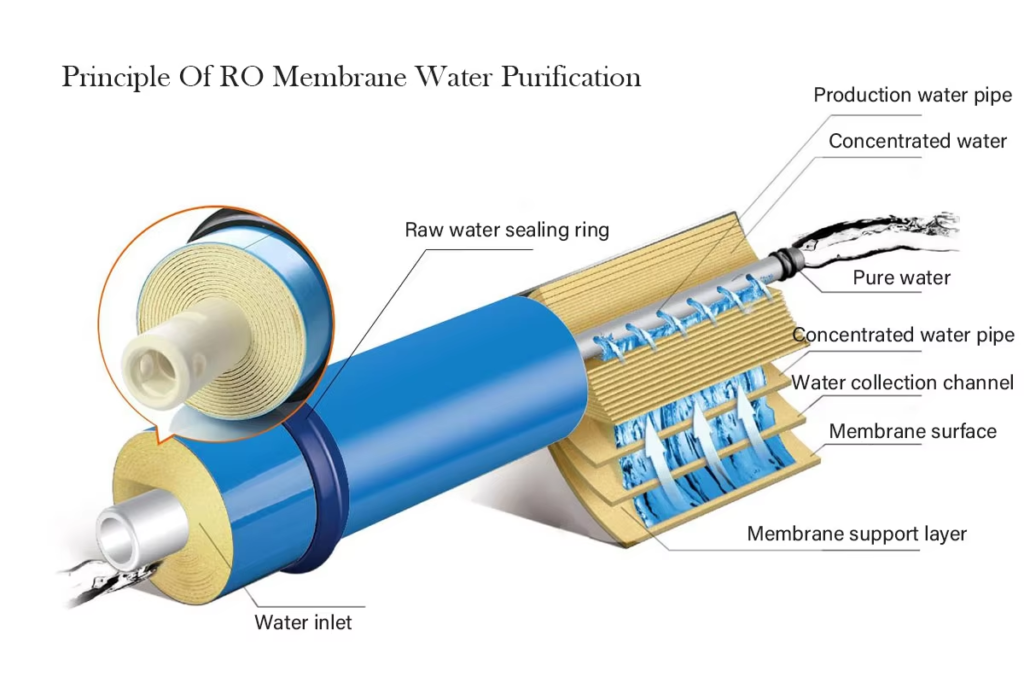
| Primary Removal | Suspended solids, turbidity, bacteria, viruses, colloids, large organics. | All of the above, PLUS >99% of dissolved salts, ions, sugars, amino acids. |
| Operating Pressure | Low (1-5 bar) | High (10-70 bar, for seawater) |
| Energy Consumption | Lower | Higher |
| Product Water | “Pure Water” – Physically purified, clear, microbiologically safe. | “Demineralized Water” – Low conductivity, approaching deionized water. |
| Typical Role | Final barrier for pathogens, pretreatment for RO, standalone clarification. | Core desalination step for producing high-purity water. |
In short: UF makes water physically pure (clear and sterile), while RO makes water chemically pure (desalinated).
🏭 Typical Applications of a 1.5 t/h UF System
A system of this capacity is suitable for small to medium-scale industrial or commercial applications:
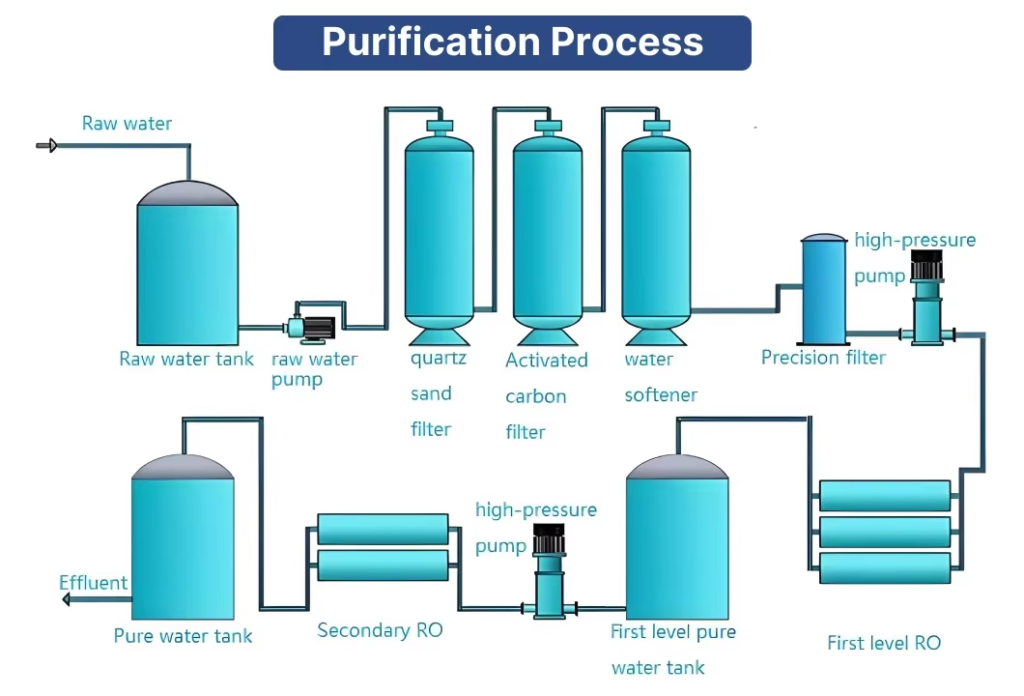
Pretreatment for RO/EDI Systems: The most common industrial use. It provides excellent protection for downstream RO membranes by removing particulates and microbes, significantly improving RO performance and lifespan.
Standalone Production of Process/Pure Water: For industries where microbiological safety is key, but dissolved solids are not a concern (e.g., certain food and beverage processes, textile washing, cooling tower makeup water).
Drinking Water Purification: For communities, hotels, or campuses, producing safe potable water from surface water (rivers, lakes) or groundwater.
Wastewater Reuse/Recycling: As a tertiary treatment step to produce high-quality reclaimed water for irrigation or non-potable uses.
Biopharmaceuticals: Used in process water systems and for separating biomolecules.
💡 Important Considerations for System Design
Feed Water Quality: The nature and concentration of suspended solids determine the frequency of backwashing and chemical cleaning, impacting operational efficiency.
Recovery Rate: Typically 90-95%. This means for 1.5 t/h of product water, you need about 1.58-1.67 t/h of feed water.
System Combinations: UF is rarely the final step for “ultrapure” water. It is often followed by RO → EDI → Polishing for semiconductor or pharmaceutical grades. For high-purity boiler feed water, the sequence might be UF → RO.