

Laboratory Water Machine
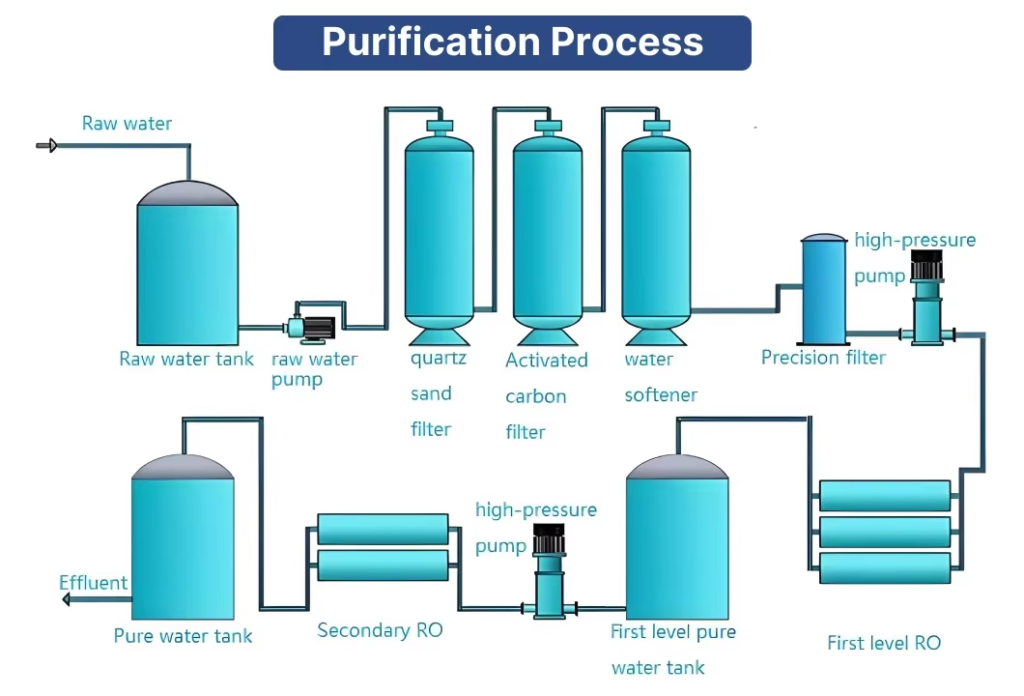
Depending on the required water quality level for the experiment, a series of processes are combined to produce pure/ultrapure water to the corresponding standards. For modern integrated laboratories, it is recommended to choose an integrated system capable of simultaneously producing secondary pure water and primary ultrapure water. The ultrapure water can be used directly, while the pure water is used for large-volume rinsing and general experiments. This approach offers the highest cost-effectiveness and efficiency.
Core Purification Technologies
Reverse Osmosis (RO): The essential pretreatment for Type I/II water. Removes >99% of ions, organics, and microbes. Can produce Type III water directly.
Electrodeionization (EDI) & Ion Exchange (IX):
EDI: Continuously removes ions under an electric field, requiring no chemical regeneration. Ideal for producing stable Type II water and as pretreatment for ultrapure systems.
Ion Exchange Cartridges: Include exchange cartridges for pure water and ultrapure polishing mixed-bed cartridges for final stage 18.2 MΩ·cm water.
Final Polishing: Includes Ultrafiltration (UF) for endotoxin/nuclease removal, UV lamps for TOC reduction and sterilization, and 0.2 μm final filters for sterile dispensing.
Common System Configurations
Central Purification Systems: Large systems distributing water via a ring-main to multiple points. Suitable for high-volume, multi-lab facilities.
Point-of-Use Benchtop/Floor-standing Units: The most common type. Integrated systems that pretreat, purify, store, and dispense. Often designed as “one system, two grades” to dispense both pure and ultrapure water simultaneously.
Laboratory Water Grades & Standards
Internationally recognized standards (ASTM, CLSI, ISO) define three primary types of laboratory water, which form the basis for system selection.
| Grade | Name | Resistivity (25°C) | Total Organic Carbon (TOC) | Microorganisms (CFU/mL) | Key Applications |
|---|---|---|---|---|---|
| Type III | Primary Grade | >0.05 MΩ·cm | <200 ppb | <1000 | Glassware rinsing, water baths, feed for higher-grade systems |
| Type II | Pure Grade | >1 MΩ·cm | <50 ppb | <100 | General reagent prep, buffer solutions, clinical analyzers |
| Type I | Ultrapure Grade | >18 MΩ·cm | <10 ppb | <1 | HPLC, ICP-MS, GC-MS, cell culture, molecular biology |