

Commerical Water Filter Ro System
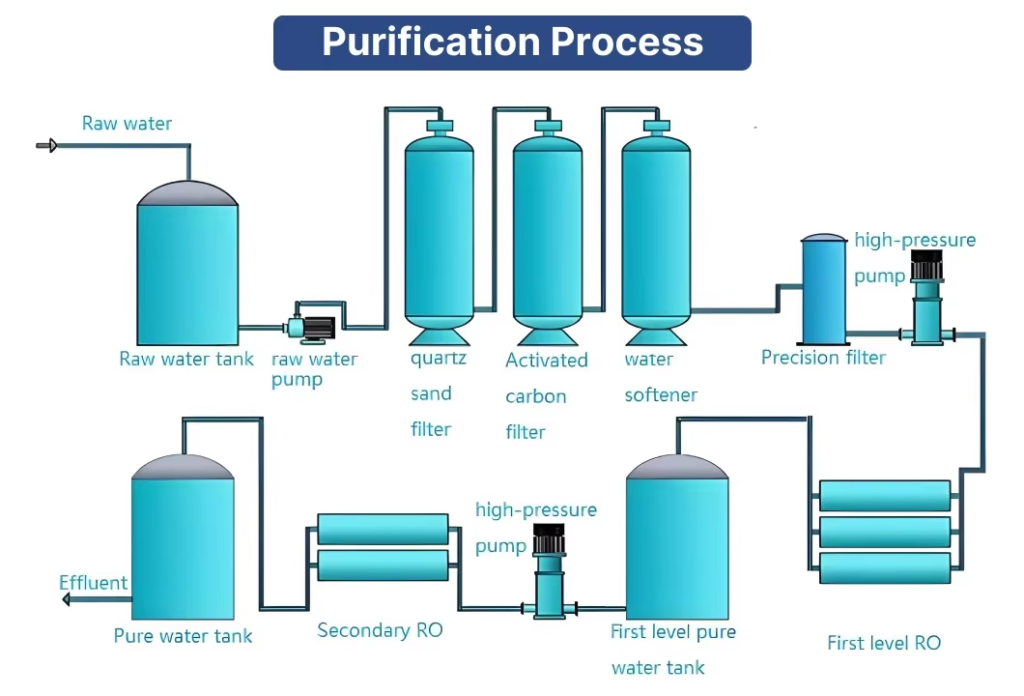
A Commercial Water Filter RO System refers to a complete, engineered water purification system built around a Reverse Osmosis (RO) core. It integrates multi-stage filtration pretreatment, the RO process itself, and often post-treatment disinfection into a single, skid-mounted unit designed for reliable, high-volume operation in business and institutional settings.The primary goal is to provide a turnkey solution that transforms municipal tap water, well water, or other challenging feed water into a consistent, safe, and high-quality water stream suitable for commercial applications.
System Definition & Core Components: Beyond Just an RO Machine
This system is characterized by its integrated design, where each stage is purposefully selected to protect and enhance the next.
| System Stage | Key Components | Primary Function |
|---|---|---|
| 1. Pretreatment Filtration | Sediment Filter: Multi-grade or bag filters. Activated Carbon Filter: Granular or block carbon. Water Softener / Antiscalant Dosing: | Removes particles, rust, sand. Removes chlorine, organics, improves taste. Prevents hardness scale on RO membranes. |
| 2. Core RO Unit | Precision Cartridge Filter (1-5 micron). High-Pressure Pump. RO Pressure Vessels & Membranes. Control Panel & Instrumentation. | Final particle guard. Provides cross-flow filtration force. The core desalination element (>95-99% rejection). Automates operation & monitors performance. |
| 3. Post-Treatment & Storage | Pure Water Storage Tank (often with air filter). UV Sterilizer or Ozone Generator. Repressurization Pump (for distribution). | Balances supply and demand. Ensures microbial safety in stored/distributed water. Delivers water at correct pressure to points of use. |
Key Applications by Industry
| Industry | Typical Uses | Required Water Quality Outcome |
|---|---|---|
| Hospitality (Hotels, Resorts) | Guest drinking water, kitchen/ice machines, laundry, pools. | Spot-free glassware/linen, clear ice, better-tasting food/beverages, protected equipment from scale. |
| Food & Beverage Service (Restaurants, Cafés) | Coffee/tea, soups, sauces, ice, steamers, beverage lines. | Consistent flavor, efficient equipment operation, compliance with health codes. |
| Healthcare (Clinics, Dental, Labs) | Instrument washing/sterilization, autoclaves, laboratory reagents. | Low conductivity, bacteria/endotoxin control, meeting strict medical equipment standards. |
| Manufacturing & Facilities | Process water, boiler/cooling tower feed water, product ingredient water. | Prevention of mineral scale in machinery, improved product quality, reduced chemical and energy use. |
Guide to Selecting a System,Conduct a Water Audit:
Test Your Feed Water: A comprehensive analysis is non-negotiable. It determines the necessary pretreatment.
Calculate Your Demand: Determine peak flow rate (GPM) and total daily volume (Gallons/day).
Specify Based on Application:
A restaurant needs great-tasting water and protection for sensitive equipment like espresso machines and ice makers.
A laundry requires very soft water to eliminate scale and reduce soap use.
Specify the final water quality needed (e.g., TDS < 50 ppm, hardness < 1 gpg).