

Reverse osmosis membrane
A transdermal membrane is a high-precision filtration medium with selective separation capabilities. Its core function is to allow water molecules to pass through under external pressure while retaining most impurities such as dissolved salts, colloids, microorganisms, and organic matter, thereby obtaining nearly pure water.
Core Characteristics & Technical Description
Key Material & Structure
Modern mainstream RO membranes are thin-film composite (TFC) membranes based on cross-linked aromatic polyamide. They consist of three layers:
Polyester Non-Woven Fabric Support Layer: Provides mechanical strength.
Polysulfone Microporous Interlayer: Forms a porous support structure.
Ultra-Thin Polyamide Separation Layer (approx. 0.2 μm thick): This is the active layer responsible for separation, featuring a rough “ridge-and-valley” surface morphology to increase the effective filtration area.
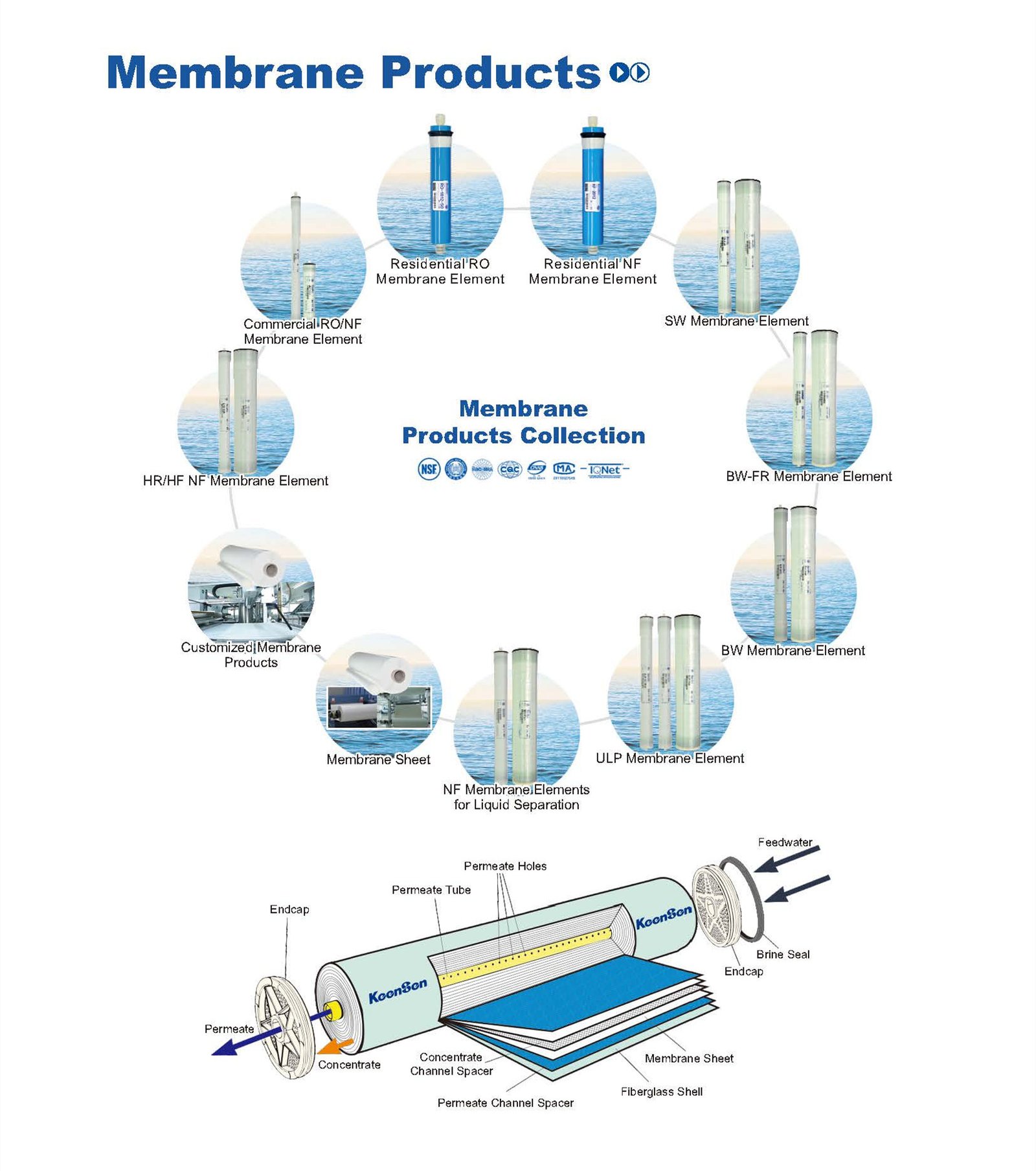
This composite structure achieves an optimal balance of high salt rejection, high water flux, and strong mechanical integrity. Membranes are typically packaged as spiral-wound elements, consisting of membrane sheets, feed spacers, and a central product tube wound together to maximize packing density and ensure stable hydrodynamics.
Key Performance Parameters
Salt Rejection: Measures the membrane’s ability to remove dissolved ions, typically >98%, and is crucial for product water purity.
Water Flux: The amount of water produced per unit membrane area per unit time, directly impacting system output and equipment size.
Recovery Rate: The ratio of product water to feed water, affecting system water efficiency. This is balanced against fouling potential in design.
Pressure & Chemical Tolerance: The membrane must withstand long-term operating pressure (typically 1-1.6 MPa or higher) and cleaning chemicals (e.g., acids, bases).
Application Fields & Specifications
RO membranes have a vast range of applications, with specifications varying significantly by scenario:
Residential Water Purifiers: Use low to medium flow (e.g., 50-800 gallons per day) spiral-wound elements, emphasizing compact size, low energy consumption, and quiet operation.
Commercial & Industrial Water Treatment: Employ high-flow standard-sized elements (e.g., 8040, 4040) for boiler feed water, process water, food & beverage production, etc.
Seawater Desalination: Use specialized seawater RO membranes designed to withstand higher feed pressure (~5.5-8.5 MPa) and high salinity.
Specialized Separation: Applications in pharmaceutical, electronics (ultra-pure water), and wastewater reuse require highly specific membrane selections.
Operation, Maintenance & Challenges
Membrane performance declines due to fouling. Primary fouling types include:
Inorganic Scaling (precipitation of calcium, magnesium, silica)
Organic Fouling (natural organic matter, oils)
Biofouling (microbial biofilm formation)
Colloidal Fouling
Therefore, a robust pretreatment system (e.g., multi-media filtration, activated carbon, antiscalant injection) and periodic chemical cleaning are essential for maintaining membrane life. Typical membrane lifespan is 2-5 years in residential and 3-7 years in industrial settings, depending heavily on feed water quality and maintenance.
Detailed Technical Description & Applications
1. Material and Hygiene Assurance
The tank’s core is high-quality stainless steel plate. SUS304 stainless steel is the standard grade, suitable for storing treated municipal water in most applications. For more corrosive environments (e.g., coastal areas, specific industrial water storage), SUS316 stainless steel with superior chloride ion resistance is used. The plate surface undergoes passivation treatment, forming a dense chromium oxide layer that provides foundational corrosion resistance. The interior high-brightness polish (mirror finish) not only enhances appearance but, more importantly, creates a surface that inhibits bacterial and algal growth, significantly improving water hygiene.
2. Structural Design and Craftsmanship
The tank’s strength and stability rely on scientific structural design. Tanks are constructed via modular panel assembly on-site or factory welding. Seams are fully welded using techniques like argon arc welding to ensure a leak-proof seal. Externally, evenly distributed vertical and horizontal reinforcement ribs effectively counteract deformation stress from water pressure, ensuring the geometric stability of large tanks under full load. Standard configurations include access manholes, internal/external ladders, vent screens, and level monitoring ports.
3. Primary Application Areas
Residential & Commercial: Secondary water supply for high-rise buildings, and storage systems for domestic cold and hot water in hotels, schools, and hospitals.
Firefighting Systems: Serving as fire water storage tanks, providing crucial water supply for initial fire suppression.
Industrial & Agricultural: Storage for process water, irrigation systems, and rainwater harvesting.
Water Treatment Systems: Used as buffer storage vessels for purified or treated water in conjunction with systems like Reverse Osmosis (RO) or water softeners.