

High-pressure water pump
A high-pressure water pump is a power device that can convert mechanical energy into liquid pressure energy. Its core function is to apply a powerful pressure far exceeding the normal pressure to the water flow, so that it can obtain higher kinetic and potential energy, thereby meeting the specific needs of various operations that require strong flushing, long-distance transportation, or penetrating operations.
| Type | Working Principle & Core Characteristics | Typical Pressure Range | Key Pros, Cons & Application Scenarios |
|---|---|---|---|
| Plunger/Piston Pump | A positive displacement pump. The motor drives a crankshaft and connecting rods, which move multiple plungers back and forth within cylinders, cyclically changing the sealed chamber volume to suck in and pressurize water. Delivers very high pressure with stable flow. | 7 MPa – 70 MPa (up to ultra-high pressure) | Pros: Extremely high pressure, stable flow, high efficiency. Cons: Complex structure, higher cost, sensitive to water quality (fears solid particles). Scenarios: Professional cold/hot water high-pressure cleaners, industrial waterjet cutting, hydraulic systems, RO seawater desalination boosting. |
| Centrifugal Pump | A kinetic pump. The motor drives an impeller to rotate at high speed, throwing water outward via centrifugal force and converting kinetic energy into pressure within the volute. Provides high flow with simple structure. | 0.5 MPa – 4 MPa (standard single-stage) | Pros: High flow rate, compact, smooth operation, easy maintenance. Cons: Limited pressure per single stage, not suitable for ultra-high pressure. Scenarios: Building water supply, HVAC systems, low-pressure rinsing, agricultural irrigation, some industrial processes. |
| Multi-Stage Centrifugal Pump | An enhanced centrifugal pump. Multiple impellers are mounted in series on the same shaft. Water gains energy progressively through each stage, culminating in higher total pressure. Balances relatively high pressure with substantial flow. | 1 MPa – 20 MPa | Pros: Significantly higher pressure than single-stage centrifugal pumps while maintaining good flow. Cons: Slightly less efficient than plunger pumps, more complex than single-stage pumps. Scenarios: Boiler feed water, high-rise building water supply, mine drainage, industrial pressurization, main booster pumps for RO systems. |
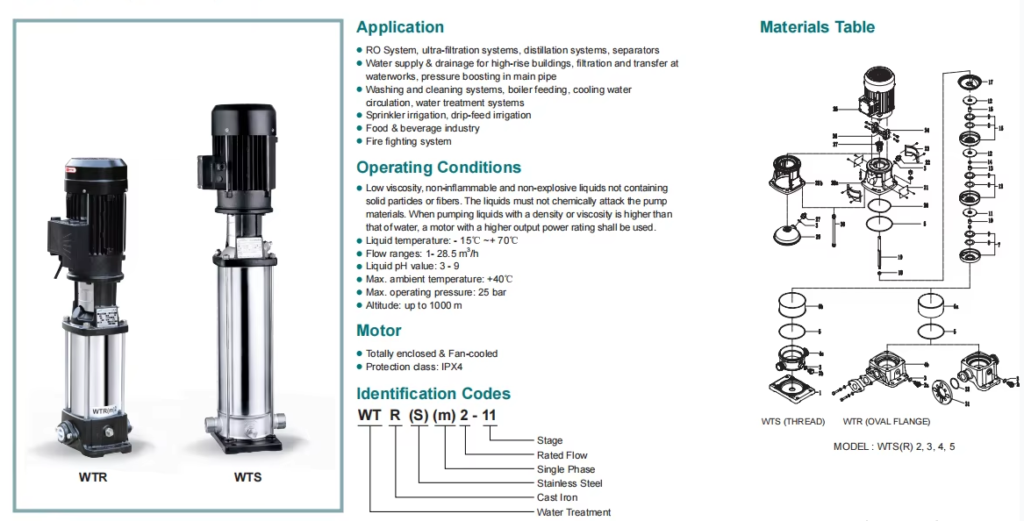
Key Application Areas:
Industrial Cleaning and Processing: Cleaning of vehicles, ships, and heat exchangers; waterjet cutting using ultra-high pressure water-mixed abrasives.
Water Treatment Systems: Providing high-pressure feed water necessary to overcome membrane osmotic pressure, serving as the core power unit for reverse osmosis systems.
Building and Municipal Engineering: Secondary water supply pressurization for high-rise buildings; pressure stabilization of fire sprinkler systems; municipal pipeline flushing.
Agriculture and Environment: Large-scale high-pressure sprinkler irrigation and spraying; chemical dosing and sludge transport in wastewater treatment.