

UV water purifier
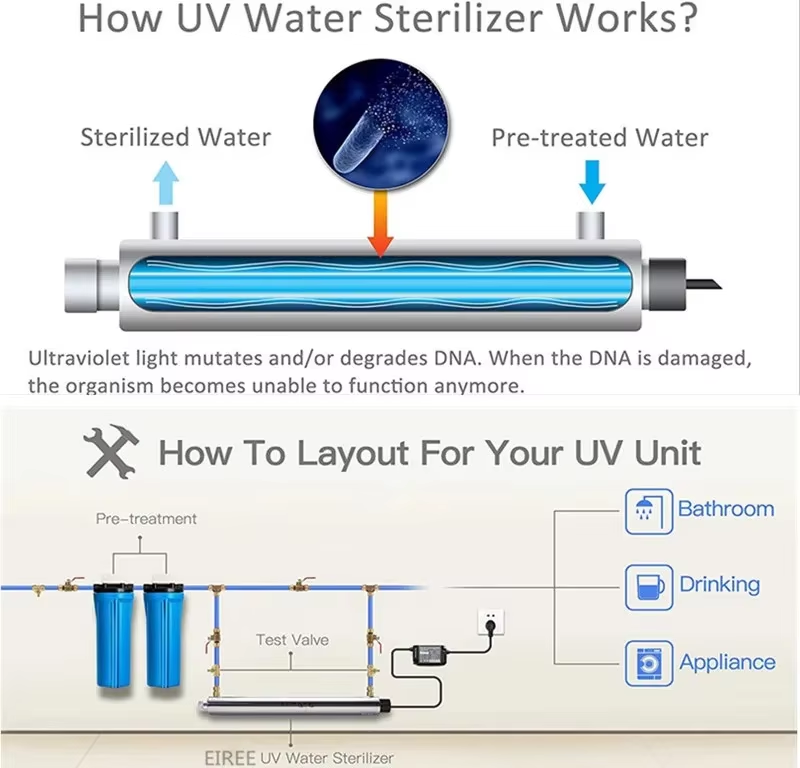
A UV water purifier, also known as an ultraviolet water purifier, is a physical disinfection device that uses ultraviolet light of a specific wavelength (mainly UVC, wavelength 254 nanometers) to irradiate water flow, thereby destroying the DNA/RNA structure of microorganisms in the water and rendering them unable to reproduce, thus achieving an immediate sterilization effect. It does not add any chemicals and does not alter the physicochemical properties of the water, making it a core terminal barrier or key treatment unit for ensuring the safety of drinking water and process water against microorganisms.
| Application Scenario | Equipment Characteristics & Core Role |
|---|---|
| Residential/Commercial Drinking Point | Point-of-Use Device: Typically compact, installed under a kitchen sink or integrated into a water dispenser. Provides final sterilization of purified water (e.g., from an RO system) to kill bacteria potentially滋生 in storage tanks or piping, ensuring biological safety of the dispensed water. |
| Municipal & Whole-House Supply | Point-of-Entry System: Higher flow capacity, installed on the main incoming water line. Provides broad-spectrum disinfection for all household water, eliminating bacteria and viruses, offering comprehensive microbial protection for domestic water. |
| Food, Beverage & Pharmaceutical | Process Water Disinfection: Used within production lines to disinfect rinse water, ingredient water, or product water, ensuring microbial compliance without chemical residue risk. A common terminal safeguard in WFI (Water for Injection) systems. |
| Aquaculture & Swimming Pools | Recirculating Water Disinfection: Continuously disinfects water in aquaculture tanks or swimming pool circuits, effectively controlling pathogen spread and algae growth, reducing reliance on chemicals like chlorine. |
| Laboratory & Electronics (Ultrapure Water) | Ultrapure Water System Polishing: Integrated into the polish loop to prevent microbial regrowth within the ultrapure water distribution system. |
Core Principle & Technical Description
Disinfection Principle
Its efficacy is based on the photochemical damage to microorganisms. When microbes are exposed to UVC light at 254 nm, the UV photons are absorbed by their genetic material (DNA or RNA), causing adjacent thymine bases to form dimers. This damage blocks genetic replication and transcription, preventing cell division and achieving “disinfection.” This process is instantaneous, and the treated water is immediately available for use.
Core Components
UV Lamp: The system’s core light source. Types include Low-Pressure Mercury Lamps (standard output) and Low-Pressure High-Output Mercury Lamps or UV-LEDs (higher intensity or specific wavelengths). Typical lifespan ranges from 9,000 to 13,000 hours.
Quartz Sleeve: A sleeve made of high-purity quartz glass that isolates the lamp from the water. Quartz has an extremely high transmittance (>90%) for UVC while protecting the lamp from water temperature and pressure, allowing maintenance without draining the system.
Reaction Chamber: A light-proof chamber, typically made of stainless steel (e.g., 304 or 316L), with a polished interior to enhance UV reflection, ensuring thorough and even exposure of the water stream.
Ballast/Controller: Provides stable power to the lamp and integrates a UV intensity sensor, timer, and alarm system for real-time monitoring of UV dose and device status.
Key Performance Parameter: UV Dose
The decisive factor for germicidal effectiveness is the “Ultraviolet Dose,” measured in mJ/cm². Dose = UV Intensity × Exposure Time. Therefore, the two keys to ensuring an effective dose are:
Sufficient Lamp Output Intensity: To counteract attenuation caused by water temperature and quality (UV transmittance).
Adequate Contact Time: Guaranteed by controlling the water flow rate.