

Industrial resin tanks
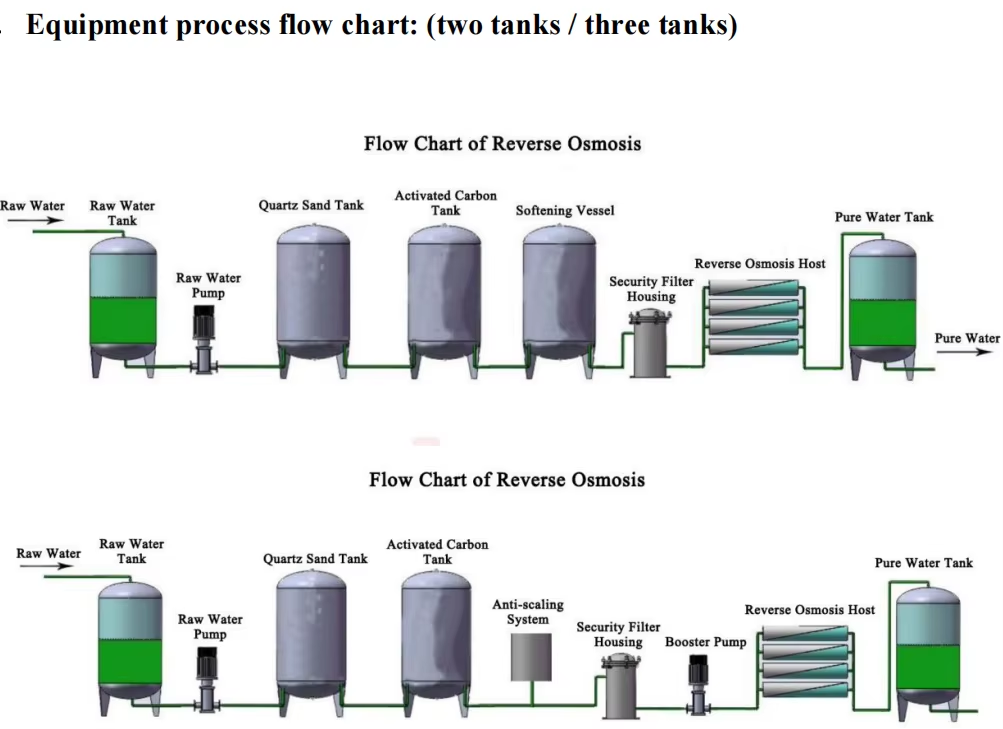
Industrial resin tanks are specialized pressure vessels used to load and contain ion exchange resins or adsorption resins. They are core equipment in water treatment processes such as softening, desalination, dealkali removal, and special separation. Their main function is to provide sufficient and stable contact space between the resin and the liquid to be treated, and through a unique internal structure, to achieve efficient automated cyclic operations such as operation, backwashing, regeneration, and forward washing.
Primary Types & Typical Applications
| Resin Tank Type | Core Application Process | Typical Resin Used | Process Characteristics |
|---|---|---|---|
| Softener Vessel | Removes calcium & magnesium ions to reduce hardness. | Strong Acid Cation (SAC) Resin (Na⁺ form) | Regenerated with NaCl brine. Produces “soft water” for scale prevention in boilers, processes, and domestic use. |
| Cation/Anion Vessel | Demineralization. Removes cations/anions, respectively. | Strong Acid Cation (H⁺) / Strong Base Anion (OH⁻) Resin | Cation vessels are regenerated with HCl or H₂SO₄; anion vessels with NaOH. Used in series to produce demineralized water. |
| Mixed Bed Vessel | Produces high-purity water via polishing. | Mixture of SAC & SBA Resins | Resins are uniformly mixed, removing nearly all remaining ions. Effluent resistivity can reach 10-18 MΩ·cm. |
| Polishing Mixed Bed | Final polishing in ultrapure water systems. | High-purity, nuclear-grade, uniform particle resin | Removes trace ions to guarantee water quality for electronics, power, and lab applications. |
| Specialty Adsorption Vessel | Targets specific contaminants (e.g., nitrate, organics). | Selective Adsorbent Resin | Designed for specific pollutant removal; the regeneration method depends on resin chemistry. |
Core Function & Structural Design
Vessel Body
Materials: Chosen based on application and corrosion resistance needs, primarily:
FRP (Fiberglass Reinforced Plastic) Tank: Manufactured from food-grade epoxy vinyl ester resin and glass fiber winding. Offers lightweight construction, excellent corrosion resistance, and electrical insulation, making it the most common type in water treatment.
Rubber-Lined Carbon Steel Tank: Carbon steel shell lined with rubber (e.g., EPDM). Provides high mechanical strength, tolerates higher temperatures and pressures, suitable for large industrial systems.
Stainless Steel Tank: Constructed from welded 304 or 316L stainless steel. High sanitary grade, corrosion resistant, often used for food, pharmaceutical, or specific chemical processes.
Design Pressure: Typically 0.4 – 0.8 MPa, complying with relevant pressure vessel design standards.
Internal Distribution & Collection System
This is critical for the tank’s efficient and uniform operation, consisting of upper and lower assemblies:
Upper Distributor/Collector: Located at the top of the resin bed. Collects treated water during service and evenly distributes incoming water during backwash to achieve proper bed expansion and fluidization.
Lower Distributor/Collector: Situated at the vessel bottom, below the resin. Distributes incoming water evenly upward through the resin bed during service, distributes regenerant (e.g., brine, acid, caustic) during regeneration, and collects waste during the rinse cycle.
Standard Accessories
Resin Fill Port / Manway: For loading, inspecting, or replacing resin.
Sight Glass / Viewport: Allows visual inspection of resin color, bed level, and backwash condition.
Sample Valve(s): For collecting inlet and outlet water samples.