

Filter cartridge
Filter cartridges are the core consumables and functional carriers for physical separation in water treatment systems. They are standardized filtration units formed by precision processes from specific filter media (such as meltblown cotton, activated carbon, resin, and membrane fibers) and placed within a rigid or porous support structure. Their core mission is to precisely remove specific suspended solids, chemical pollutants, microorganisms, or ions from water through mechanisms such as interception, adsorption, and ion exchange, thereby accurately improving water quality.
Based on their core media and filtration precision, cartridges play distinct roles ranging from coarse to fine filtration.
| Type | Core Media/Technology | Filtration Rating | Primary Function & Target Contaminants | Typical Application |
|---|---|---|---|---|
| PP Sediment Cartridge | Polypropylene Melt-Blown Fiber | 1-100 Microns | Depth Filtration. Primarily removes large particles like silt, rust, colloids, and suspended solids. High dirt-holding capacity. Often the “first line of defense.” | Whole-house inlet pre-filtration, 1st stage pretreatment for RO systems, and protection for industrial cooling water. |
| Activated Carbon Cartridge | Granular Coconut Shell/Coal-Based Carbon, Carbon Block | 0.5 – 50 Microns (for blocks) | Adsorptive Filtration. Uses vast surface area to adsorb chlorine, color, odors, and some organic compounds (VOCs). Improves taste and odor. | Improving drinking water taste, protecting RO membranes from chlorine oxidation, and water purification in the food & beverage industry. |
| Carbon Block Cartridge | High-Density Sintered Activated Carbon | 0.5 – 10 Microns | Combines adsorption with fine particle retention. Effectively filters particulates while adsorbing contaminants. | Pretreatment stages requiring both particle and taste/odor reduction. |
| Ceramic Cartridge | Diatomaceous Earth Sintered | 0.1 – 1.0 Microns | Surface Sieving. Can be repeatedly scrubbed clean. Removes bacteria, sediment, and rust. Does not remove chemical contaminants. | Physical filtration where chemical contamination is not a concern, e.g., outdoor water bottles and basic gravity filters. |
| Ultrafiltration (UF) Membrane Cartridge | Hollow Fiber Membrane | 0.01 – 0.1 Microns | Size Exclusion Separation. Removes 100% of bacteria, colloids, and large organic molecules while retaining minerals. Requires periodic flushing. | Whole-house water filtration (mineral retention), mineral water production, and industrial wastewater recovery. |
| Reverse Osmosis (RO) Membrane Element | Polyamide Thin-Film Composite | 0.0001 Microns | Molecular-Level Separation. Under high pressure, it allows only water molecules to pass, removing heavy metals, viruses, dissolved salts, antibiotics, and nearly all soluble impurities. Produces purified water. | Household drinking water, seawater desalination, boiler feed water, and ultrapure water for electronics. |
| Ion Exchange Resin Cartridge | Cation/Anion Exchange Resin | Ionic Level | Ion Exchange. Removes calcium & magnesium ions (softening) or various ions (deionization) via exchangeable ions on the resin. | Core of water softeners, domestic softening cartridges, and lab water polishing. |
| Composite Cartridge | Multiple Media Combined | Varies by Combination | Integrates multiple functions (e.g., PP + Carbon + Scale Inhibitor) for all-in-one multi-stage filtration, simplifying system design. | Under-sink filters and commercial dispensers prioritize easy installation. |
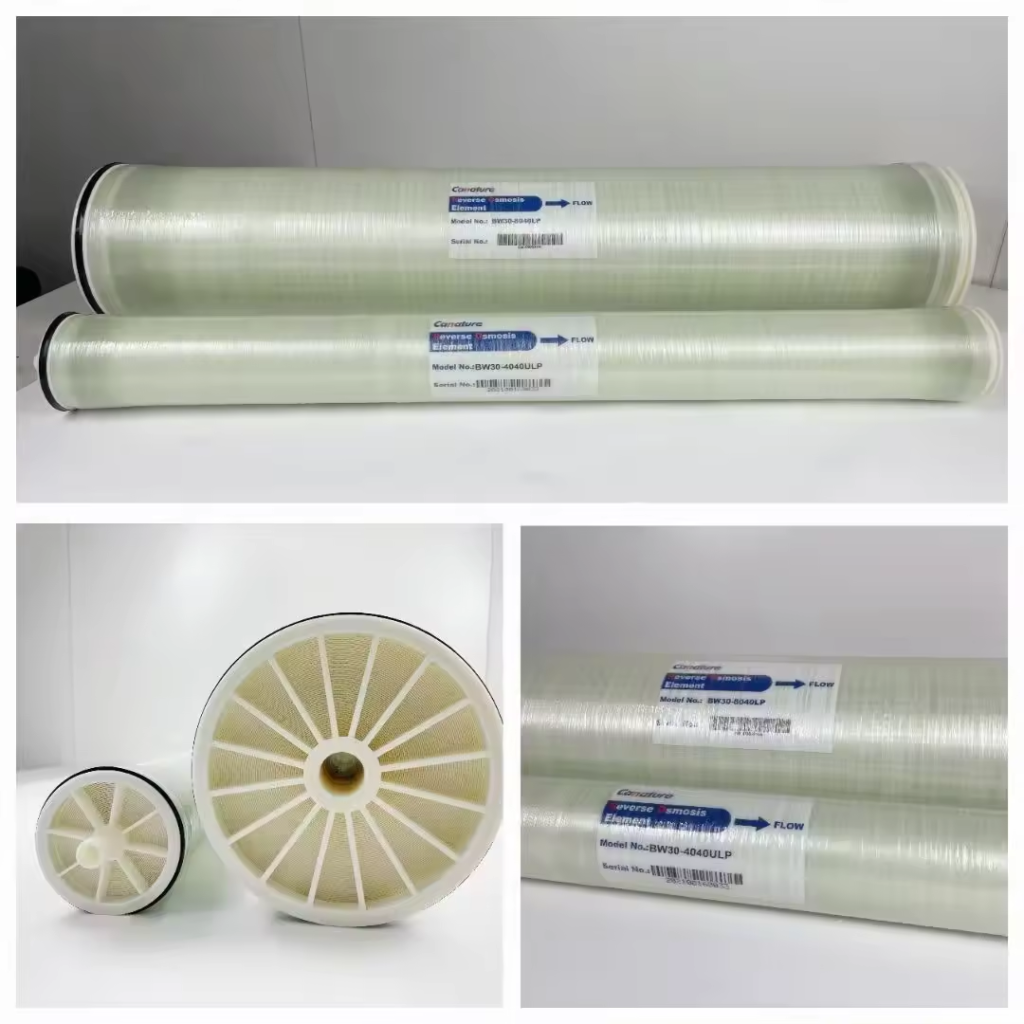
Core Construction, Technology & Key Performance Parameters
Typical Structure:
Outer Protective Layer: Often non-woven fabric or plastic mesh, protecting the inner media.
Filtration Media Layer: The “soul” of the cartridge, determining its performance.
Center Tube/Support Core: Usually a perforated plastic or stainless-steel tube, providing structural support and channeling filtered water.
End Caps & Seals: Ensure a tight seal between the cartridge and the housing to prevent “bypass” (unfiltered water leaking through).
Key Performance Parameters:
Filtration Rating: The size of the smallest particle effectively retained, defining the cartridge type.
Initial Pressure Drop: The difference between inlet and outlet pressure for a new cartridge at rated flow. Lower is better for flow.
Dirt Holding Capacity: The total amount of contaminant a cartridge can hold before clogging, determining its service life.
Flow Rate: The volume of water filtered per unit time, impacting user experience.
Chemical Compatibility: The cartridge material’s resistance to the chemical properties (e.g., pH, oxidants) of the fluid.
Scientific Selection & Application Guide
Selecting a cartridge requires a systematic approach based on water analysis and needs.
“Three-Step” Selection Logic:
Step 1: Water Diagnosis: Identify the core issues with the source water (high sediment? high hardness? heavy metals? odor?) via test reports or common local problems.
Step 2: Define Requirements: Clarify the filtration goal (protecting downstream equipment? producing potable water? specific process water?).
Step 3: Match the Solution: Based on steps 1 & 2, choose a targeted, progressively finer cartridge sequence. A classic path for
high-sediment tap water → drinking wateris: PP Sediment (intercepts solids) → Activated Carbon (adsorbs chlorine) → RO Membrane (removes dissolved contaminants) → Post-Carbon (polishes taste).
Installation & System Compatibility:
Confirm the cartridge’s connection type and size (e.g., standard 10-inch, quick-connect) matches the filter housing.
Observe the flow direction arrow on the cartridge. Incorrect installation severely reduces efficacy and can damage the cartridge.
In multi-cartridge systems, always arrange cartridges in order of increasing fineness to protect delicate, expensive downstream elements like RO membranes.