
Complete Configuration List of Laboratory Ultrapure Water Preparation System (0.25T/H)
System Model: Lab-RO-250UL
Core Process: Pretreatment + Two-stage RO + EDI (or polishing mixed bed) + Terminal fine filtration/UV
Designed Water Production: 0.25 cubic meters/hour
Inlet Water Source: Municipal tap water
Product Water Standards: Stage 1 RO water: conductivity <10μS/cm; Ultrapure water: resistivity ≥18.2 MΩ·cm @25℃, TOC < 5 ppb
Typical Applications: Central laboratories of universities/research institutes, biomedical R&D centers, quality inspection agencies, water supply for precision analytical instruments (ICP-MS, HPLC)
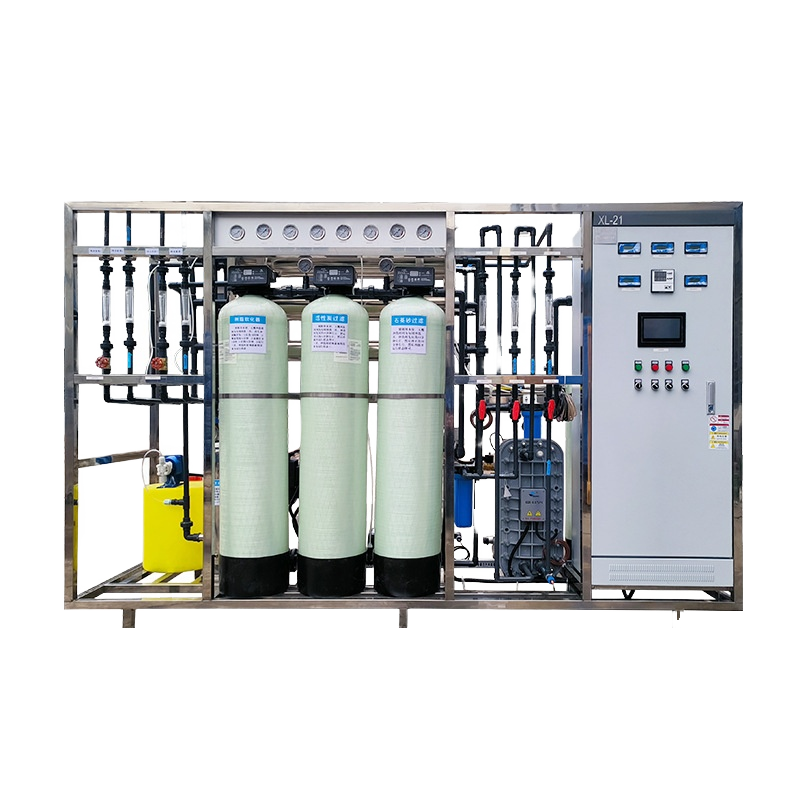
Core Configuration List and Industry Highlights
Module 1: Enhanced Pretreatment Unit
Dual-stage Softener: Prevents RO membrane scaling and ensures stable recovery rate.
Ultrafiltration Pretreatment (Optional): Acts as a post-activated carbon safety measure, further reducing SDI and providing optimal feed water for the two-stage RO system.
Key Point: TOC control is crucial; high-performance nuclear-grade resin activated carbon must be used and regularly disinfected.
Module 2: Two-stage Reverse Osmosis Unit
First-stage High-Pressure Pump and RO Membrane: Removes over 99% of ions and organic matter.
Second-stage High-Pressure Pump and RO Membrane: Uses the first-stage permeate as feed water for further purification. The second-stage RO system has interlock protection for the conductivity of the first-stage permeate.
Key Point: Optimized system recovery rate; typically employs a first-stage concentrate reflux design to improve overall water utilization.
Module 3: Ultrapurification and Terminal Supply Module
Electrodeionization (EDI) Module: Continuously produces high-purity water with a resistivity of 15-17 MΩ·cm without chemical regeneration.
Or polished mixed-bed ion exchanger: as a backup or to ensure a final water quality of 18.2 MΩ·cm.
Terminal ultrafiltration filter: 0.22μm or 0.1μm pore size, removes bacteria and pyrogens.
Dual-wavelength ultraviolet sterilizer (185/254nm): simultaneously sterilizes and degrades TOC.
Nitrogen-sealed pure water tank: prevents water quality degradation caused by dissolved CO₂ in the air.
Key points: The circulating disinfection system and pure water distribution loop must have periodic pasteurization or chemical disinfection functions.
Module Four: Intelligent Monitoring and Data Traceability System
Online water quality monitors: resistivity meter, online TOC analyzer, particle counter.
Touchscreen with audit trail function: records all operating parameters, water quality data, and alarm events, compliant with GLP regulations.
Key points: System integrity; all pipes, valves, and water tanks in contact with pure water are made of 316L stainless steel or high-purity inert plastics (such as PVDF, PFA) to ensure no precipitation.