

Commercial reverse osmosis
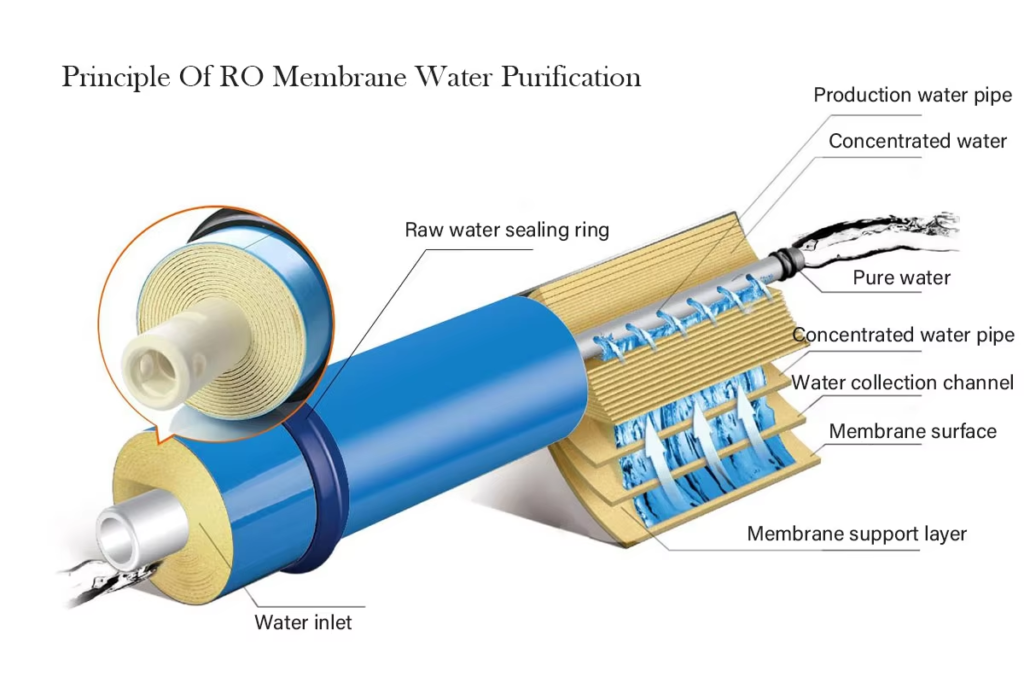
A commercial RO (reverse osmosis) system is an industrial-scale water treatment device that uses high pressure to force raw water through a semi-permeable membrane (RO membrane), effectively removing dissolved salts, ions, organic matter, bacteria, and viruses (removal rates are typically >95-99%). Its core objective is to stably and economically produce large quantities of purified water.
Primary Commercial Applications & Water Quality Requirements
| Application Sector | Core Use | Critical Water Quality Requirements |
|---|---|---|
| Food & Beverage Service | Beverages, ice, soups, cooking | Pure taste, odorless, low TDS (<50ppm), ensures food flavor, clear ice. |
| Hotels/Schools/Offices | Drinking water, central kitchen, laundry, pool top-up | Microbiologically safe, good taste, low hardness, prevents equipment scaling, enhances experience. |
| Food & Beverage Processing | Ingredient water, rinse water, product mixing | Compliance with potable water standards (e.g., EPA, local codes) and specific industry norms, low bacterial count. |
| Healthcare Facilities | Sterile processing, labs, dental units | Low bacteria, endotoxin-free, low conductivity, meets medical water protocols. |
Key Purchasing Factors & Decision-Making Process
Selecting a commercial RO system requires a professional approach to avoid incorrect specifications.
Precise Needs Analysis
Daily Water Volume: Calculate peak hourly and total daily demand from all use points, adding a 20-30% safety margin.
Feed Water Quality: Professional water analysis is mandatory (TDS, hardness, chlorine, COD, etc.). This is the sole basis for system design.
Installation Site: Confirm space, floor loading, power supply, drainage, and water inlet availability.
Evaluate Key System Performance Metrics
Rated Production Capacity: Stable output under standard conditions, not peak flow.
System Recovery Rate: Ratio of product water to feed water. Typically 50-75% for commercial systems. Higher rates mean better water efficiency and lower waste.
Core Component Brands: Assess quality of key parts: RO membranes (e.g., DuPont, Hydranautics), pumps (e.g., Grundfos, Pentair), control valves.
Assess Supplier Expertise
Customization Capability: Can they provide a tailored solution based on your water report and specific needs?
Service & Support: Do they offer professional installation, operator training, scheduled maintenance, and reliable spare parts/emergency response?
Summary & Recommendation: Choosing a commercial RO purifier is fundamentally about selecting reliable “production equipment” and a long-term “service partner.” Do not base the decision solely on initial purchase price. Instead, conduct a comprehensive evaluation of the system’s long-term stability, total cost of ownership (including consumables), and the supplier’s service capability.