

Soft water treatment equipment
Water softening equipment is a water treatment system specifically designed to remove calcium and magnesium ions from water, thereby reducing water hardness and producing “soft water.” Its core value lies in preventing scale formation, fundamentally protecting pipes and equipment, improving water quality, and significantly reducing energy consumption and maintenance costs.
Commercial and Industrial Sector (Process Soft Water)
- Critical Equipment Protection: Providing high-quality pretreated water for boilers, cooling circulation systems, reverse osmosis systems, heat exchangers, etc., is a critical barrier against scale buildup, corrosion, and efficiency degradation.
- Improved Product Quality,In industries such as food and beverage, brewing, textile printing and dyeing, electroplating, and laboratories, stable soft water is essential for ensuring process stability and product quality.
- Reduced Operating Costs: Achieving significant long-term economic benefits through scale prevention, energy saving, and reduced equipment downtime for cleaning and maintenance.
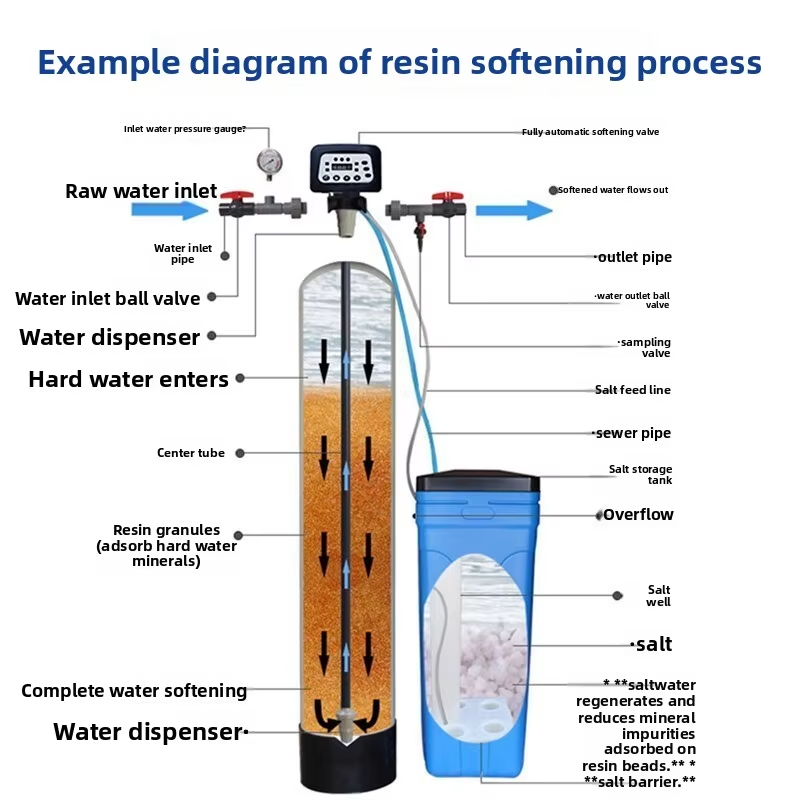
Key Components & Functions
| Component | Function Description |
|---|---|
| Resin Tank | The main vessel that holds the ion exchange resin, providing the site for the ion exchange process. |
| Brine Tank | Used to dissolve and store the regenerant (industrial salt/sodium chloride) and supply saturated brine for regeneration. |
| Control Valve | The “brain” of the system. This multi-port valve controls water flow direction and automates the entire cycle: Service, Backwash, Brine Draw/Slow Rinse, Fast Rinse, Brine Tank Refill. |
| Resin | The core consumable media, typically food-grade, strong acid cation exchange resin. Its quality and volume determine soft water output capacity and efficiency. |